
The OSM Unveils Its Eco-Responsibility Policy
On this Earth Day, the OSM is proud to unveil its very first Eco-responsibility Policy. This commitment will guide us for the next few years in the improvement of all our practices. You will be able to follow our actions and our progress in the coming months on our social media and in our official communications.
We are accompanied in this process by the Réseau des femmes en environnement, thanks to the support of the Caisse de dépôt et placement du Québec (CDPQ) and the Fonds d’action québécois pour le développement durable (FAQDD). We would like to take this opportunity to thank them for their support!
Discover also

OSM welcomes its new Chief Executive Officer
The Orchestra’s administrative staff and musicians, as well as Music Director Rafael Payare and Chorusmaster Andrew Megill are honoured and delighted to welcome their new Chief Executive Officer Mélanie La Couture. Ms. La Couture’s remarkable career as President and Chief Executive Officer of the Montreal Heart Institute and her previous experience with our institution, notably as Chief Operating Officer from 2007 to 2013, are major assets that inspire our strong confidence in the OSM’s future. Many current members of the Orchestra and administrative staff retain fond memories of her years with us; this clearly attests to her positive impact on our professional community. On behalf of every member of the OSM team, we extend a very warm welcome to Ms. La Couture in her new position. We look forward to working with her to continue raising the OSM’s profile and supporting its mission of excellence and innovation. “It is an honour for me to return to the OSM as Chief Executive Officer. After my departure from the Orchestra back in 2013, I have continued—albeit from a distance—to follow the activities of this great cultural institution, and I am truly excited to be working with its high-quality administrative teams and with Rafael Payare, whose dynamism, and whose eagerness to embrace the Montreal and Quebec community are undeniable. The OSM’s administrative and artistic foundations have continued to gain in sustainability, and I am proud to add my contribution to those of the Orchestra’s builders and musicians.”— Mélanie La Couture, OSM new Chief Executive Officer.
Poulenc’s “Intensely Human” Voice, Signed Barbara Hannigan
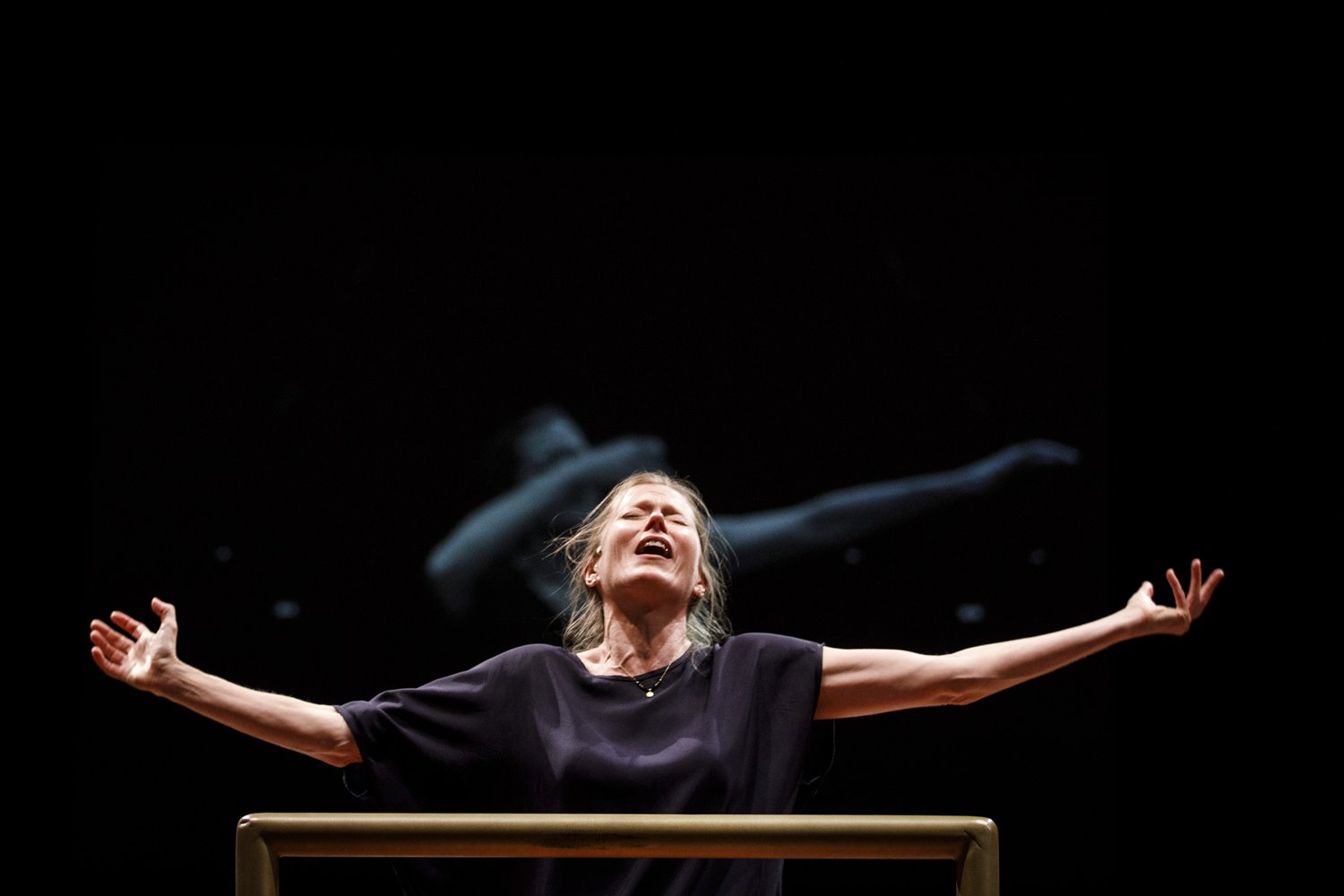
World-renowned Canadian soprano and conductor Barbara Hannigan will be back at the Maison symphonique for four concerts with the OSM. On February 21 and 22, she will conduct and sing in a programme devoted to Richard Strauss and Francis Poulenc; and then on February 28 and 29, she will perform Zosha Di Castri’s In the Half-Light, conducted by Rafael Payare. “Being a musician and making music is the thing that makes me happiest” — Barbara Hannigan The artist transmits this joy with great intensity, and she shares her art unreservedly with her audience. The highlight of her presence at the Maison symphonique will be her performance of Poulenc’s La voix humaine, in a stage production she has created with video artist Denis Guéguin and video stage director Clemens Malinowski. This production, which has garnered huge success in Europe, will be presented for the first time in North America. La voix humaine by Cocteau and Poulenc Jean Cocteau’s play, written in 1929 is based on a woman (Elle)’s telephone conversation with a lover who has just left her. Paradoxically, the stripped-down, highly realistic nature of the text accentuates the dramatic aspect of the situation, making it even more bitter. The telephone symbolizes the distance, estrangement and isolation experienced by Elle. In 1958, Poulenc composed a one-act operatic tragedy, or monodrama based on Cocteau’s text. The composer endowed the vocal score with the freedom of speech, as well as many vocal nuances that convey the astonishing range of emotions of the protagonist. The many instances of silence, which play a crucial role in the unfolding of the tragedy, allow the audience to become involved in the drama being played out, while leaving them the freedom to imagine the nature of the ex-lover’s responses in relation to their own sensibilities. Cocteau’s play and Poulenc’s monodrama have been staged several times and adapted for film and television. Barbara Hannigan offers a stirring, highly personal new reading. La voix humaine, by Barbara Hannigan Barbara Hannigan is a true star of the classical world. Adored by the greatest conductors, and the muse of several composers who regularly write for her, Barbara Hannigan is one of the rare women to combine singing with conducting, and the most renowned opera houses are snapping her up. The curiosity and highly evolved taste for experimentation that characterize the artistic approach of this sublime artist have prompted her to revisit Poulenc’s work in a production combining live video projection and pre-recorded film. Three cameras in the orchestra and a screen behind the formation will enable the audience to follow her gestures and acting. Cocteau stated that his play gave the performer the opportunity to play two roles: the first one when speaking, the second when listening. Barbara Hannigan will play not two, but three roles, as she will also conduct the OSM simultaneously. The original concept of this production is partly the result of choices made by the artist, the video artist and the stage director. Elle, the heroine of the monodrama, is presented as a woman struggling with her passion, caught between lies and sincerity, trying to control her emotions; she carries all the energy that Barbara Hannigan gives her. However, Hannigan leaves some doubt as to the presence of the ex-lover: does he exist or is he a fantasy of the abandoned Elle? In this production of La voix humaine, Barbara Hannigan, who describes herself as an “actress who sings” rather than a singer who acts, achieves a tour de force and delivers an extraordinary concert performance. Treating the stage as an extension of herself, Barbara Hannigan invests herself both physically and intellectually, to “become the music” and embody the dramatic character, always seeking to be authentic in her interpretation. With her expressive vocal and physical power, she deploys her the gift of capturing the audience’s attention and of keeping them on the edge of their seats. She has the power to deeply move her audiences and to make them think and take part in the action. “Audiences are drawn to high-level performances, it’s like in sport” — Barbara Hannigan On February 21 and 22, Barbara Hannigan will also conduct Richard Strauss’ Metamorphoses, an instrumental work of exquisite lyricism. The loss, the impossible return and the sincerity expressed by Strauss link him to Poulenc, shaping this concert’s dramatic and dramaturgical unity. Come out and experience this formidable artist, and share in the intense, authentic emotions and peerless quality of her innovative concert approach!